our operations
explainer: what is the permian basin?
3 min read | august 06, 2025
Chevron is now producing an average of 1 million barrels of oil-equivalent per day from the Permian Basin.
Chevron has been producing in the Permian Basin for a century.
The Permian Basin is an oil- and gas-rich region spanning parts of West Texas and New Mexico.
And Chevron is among the largest producers there. Chevron is now producing an average of 1 million barrels of oil-equivalent per day from the Permian Basin.

The Permian Basin spans parts of New Mexico and Texas.
what makes the permian basin a powerhouse?
The Permian Basin is the largest oil-producing region in the United States.
In fact, energy research and consultancy group Wood Mackenzie projects that nearly 70% of oil production from the lower 48 states will come from the Permian before 2040.
So what makes the Permian Basin one of the most prolific fields in the world? It all comes down to unique rock characteristics. The basin’s geology has several layers of shale rock that contain oil and natural gas.
powering state economies
Beyond production, the Permian Basin is an economic engine for New Mexico and Texas, as well as the United States.
one-third
Approximate percentage of New Mexico’s fiscal year 2024 budget funded by oil and gas taxes and royalties
$27.3 billion
Amount the Texas oil and gas industry paid in 2024 taxes and royalties.
850,000
Number of U.S. jobs supported by the Permian Basin in 2023.
chevron’s history in the permian
Chevron’s success in the Permian Basin all began with the laying of some train tracks.
In 1871, the Texas & Pacific (T&P) Railway Company was chartered to construct the Southern Transcontinental Railroad. The T&P was given several square miles of surface rights (rights to the land’s surface) and mineral rights (rights to the natural resources beneath the land’s surface) in exchange for each mile of track laid.
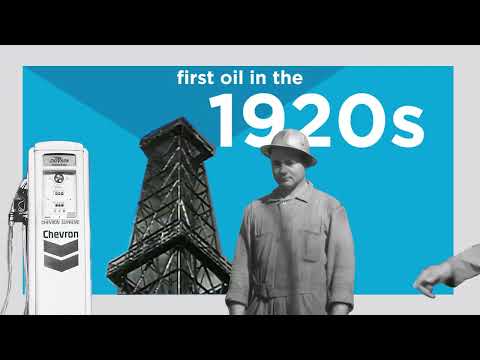
Chevron has a long history and a diverse portfolio in the Permian Basin.
But when the T&P went bankrupt years later, its 3.5-million-acre land grant was put into a trust. Texaco bought 2 million of these acres, and when Chevron acquired Texaco, it became the basis of the company’s significant presence in the Permian today.

Chevron began producing in the Permian Basin in 1925.
a winning edge
Chevron believes its long-standing presence in the Permian Basin can give it several advantages over its competitors.
For starters, Chevron has a revenue interest in one in every five Permian Basin wells. This gives the company visibility into operations and data across the basin.
Leveraging technology and artificial intelligence (AI), Chevron can unlock insights from this data to improve decision-making and performance. Linking AI to this broad presence allows for:
- Improved well design and execution
- Enhanced decision-making

leveraging strengths for efficiencies
Chevron continues to unlock value though a wide range of technologies. For instance, hydraulically fracturing multiple wells simultaneously, also known as the triple-frac technique, saves time and money. A key aspect of releasing resources from Permian rock formations is the use of horizontal drilling and hydraulic fracturing—technologies that became more widely used in the 2010s to help reach previously trapped oil and gas. Longer horizontal wells and hydraulic fracturing are more efficient than older methods, reaching more of the resource at a lower cost.
topics covered


related content
-

 how APOLO helps chevron pinpoint prime drilling locations
our operationsnovember 12, 2025
-

 robotics supports more efficient workplace
our operationsnovember 10, 2025
-
 the people who power the US energy advantage
our operationsnovember 06, 2025
-

 a statement from chevron CEO mike wirth on Argentina
our operationsseptember 24, 2025
chevron email updates
Subscribe to our newsletter to receive news and updates.